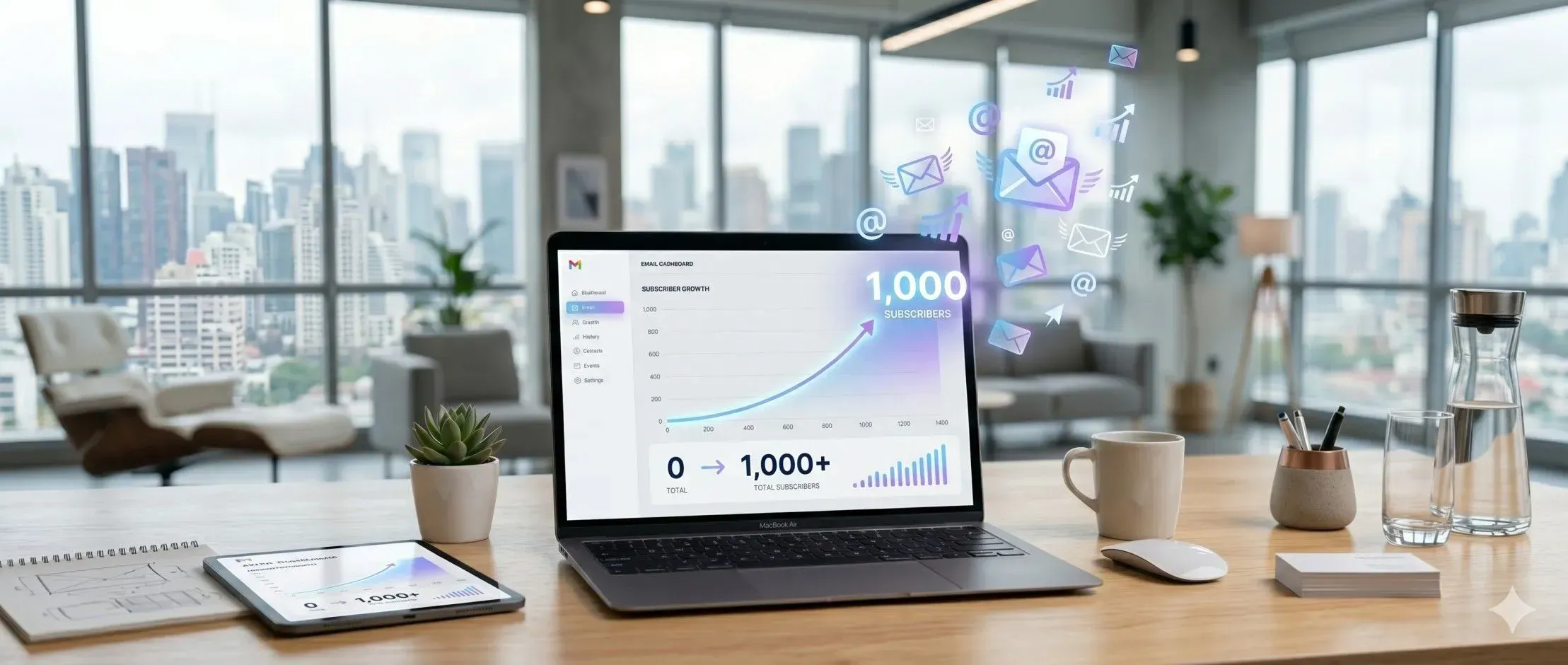
Building your first 1,000 email subscribers can feel like an uphill battle—especially when you’re starting with zero audience, no brand recognition, and limited resources.
But here’s the truth: you don’t need a massive social media following or a huge ad budget to build a powerful email list. You just need the right email marketing strategy, consistency, and a deep understanding of your target audience.
This guide walks you through a practical, step-by-step approach to growing an engaged email list and getting your first 1,000 subscribers from scratch.
Why Your First 1,000 Email Subscribers Matter
Your first 1,000 subscribers are more than just vanity metrics. They are your early adopters, your direct feedback loop, and often your very first paying customers.
These early subscribers will:
- Trust you enough to invite you into their highly guarded inbox.
- Engage more actively than subscribers who join later.
- Help shape your future content, products, and offers.
Pro Tip: Think of this initial phase as building a rock-solid foundation, not just chasing scale.
Step-by-Step Guide to Getting Your First 1,000 Subscribers
Step 1: Define a Clear Value Proposition
Before asking anyone to subscribe, you must answer one critical question: Why should someone join your email list?
Avoid vague, generic promises like "Get updates" or "Join my newsletter." Instead, be highly specific about the transformation or knowledge you are offering.
Examples of strong value propositions:
- “Learn how to grow a SaaS from 0 to 10K users.”
- “Weekly actionable tips on email marketing.”
- “Free templates and growth hacks for digital creators.”
Your value proposition must be: Clear, outcome-driven, and targeted to a specific niche.
Step 2: Create an Irresistible Lead Magnet
People rarely give away their email addresses for nothing. You need to offer a compelling incentive, commonly known as a lead magnet.
High-converting lead magnet ideas:
- Checklists: (e.g., “The Ultimate 10-Step Product Launch Checklist”)
- Templates: (e.g., Cold email scripts, Notion dashboards)
- Guides: Mini eBooks or comprehensive PDF guides.
- Tools: Free calculators, spreadsheets, or resource lists.
- Exclusive Data: Case studies or industry reports.
To make your lead magnet successful, ensure it solves one specific problem, delivers a quick win, and is instantly accessible.
Step 3: Build a High-Converting Landing Page
You don’t need a complex website to start capturing emails—just a clean, focused landing page.
Essential elements of a landing page:
- Strong Headline: Clearly state the benefit of your lead magnet.
- Short Description: Briefly explain what they will get.
- Visual Proof: A mockup or image of the lead magnet (optional but highly recommended).
- Email Signup Form: Keep it simple (just ask for an email and an optional first name).
- Call-to-Action (CTA): Use action-oriented text like “Download the Free Guide,” “Get Instant Access,” or “Join 500+ Marketers.”
Remove all distractions. There should be no unnecessary links, menus, or clutter.
Step 4: Drive Traffic (Without Paid Ads)
You don’t need to spend money on Facebook or Google ads to reach your first 1,000 subscribers. Focus on these organic marketing channels:
- Social Media Content: Share insights, tips, and mini-lessons on platforms like X (Twitter), LinkedIn, or Instagram. Always include a CTA linking back to your lead magnet.
- Niche Communities: Participate authentically in Reddit forums, Discord groups, and Facebook groups. Provide high-quality value before ever dropping a link to your list.
- Your Personal Network: Share your landing page with friends, colleagues, and existing LinkedIn connections.
- Content Platforms: Write SEO-optimized blog posts or publish articles on Medium. Embed your signup link naturally within the text.
Step 5: Optimize Your Signup Experience
Small tweaks to your forms can dramatically increase your conversion rates.
Best practices for optimization:
- Use benefit-driven CTAs rather than "Submit."
- Add social proof nearby (e.g., “Join 1,000+ weekly readers”).
- Ensure the landing page is 100% mobile-friendly.
- If you have an active website, utilize exit-intent popups or inline embedded forms.
Step 6: Set Up a Welcome Email Sequence
Your job doesn’t end when someone hits "subscribe"—it’s just beginning. You need to nurture them immediately using an automated welcome sequence.
A proven 4-part welcome sequence:
- Email 1: Deliver the promised lead magnet immediately.
- Email 2: Introduce yourself, your background, and your story.
- Email 3: Share your absolute best insight, tip, or piece of evergreen content.
- Email 4: Ask a question to encourage a reply and boost your sender reputation.
Step 7: Stay Consistent with Content
When it comes to email marketing, consistency beats perfection. Decide on a realistic frequency—whether that's a weekly newsletter, bi-weekly insights, or daily short tips—and stick to it. Focus on delivering practical value, personal insights, and real-world experiences.
Step 8: Leverage Referrals and Word-of-Mouth
Your early subscribers are your best marketers. Encourage them to share your content to help you grow faster.
- Add a “Forward to a friend” CTA at the bottom of your emails.
- Offer referral incentives (e.g., unlock a bonus guide for referring 3 friends).
- Include a simple line like: “Know someone who would find this useful? Share this email with them!”
Step 9: Track Your Metrics and Improve
Pay attention to the data to see what is resonating with your audience.
Key email marketing metrics to track:
- Conversion Rate: (Website Visitors → Subscribers)
- Open Rate: Are your subject lines working?
- Click-Through Rate (CTR): Is your email content engaging?
- Unsubscribe Rate: Are you sending relevant content?
Optimize based on this data. Test different landing page headlines, refine your lead magnet, and experiment with your messaging.
Common List-Building Mistakes to Avoid
| The Mistake | Why It Hurts Your Growth | The Fix |
|---|---|---|
| Targeting Everyone | Broad messaging appeals to no one and lowers conversion rates. | Niche down. Speak directly to a specific audience with a specific problem. |
| Overcomplicating the Funnel | Too many steps or form fields create friction, causing users to abandon the page. | Keep it simple. Ask for an email address only, and deliver the reward instantly. |
| Inconsistent Emailing | Subscribers will forget who you are, leading to high unsubscribe rates and spam complaints. | Commit to a schedule (e.g., every Tuesday morning) and stick to it strictly. |
| Ignoring Engagement | Focusing purely on list size over list health damages your sender reputation. | Regularly clean your list and write content that encourages replies and clicks. |
Frequently Asked Questions (FAQs)
How long does it take to get 1,000 email subscribers?
The timeline varies based on your existing network and content output. If you consistently publish high-quality content and promote a strong lead magnet daily, you can hit 1,000 subscribers in 3 to 6 months organically.
Do I need a website to build an email list?
No. You can start by using standalone landing page builders provided by email marketing software (like ConvertKit, MailerLite, or Beehiiv) to collect emails without paying for website hosting.
Final Thoughts & Action Plan
Getting your first 1,000 email subscribers isn’t about magic hacks or hidden shortcuts—it’s about delivering consistent value, building trust, and showing up regularly.
Quick Recap Action Plan:
- Define your niche and craft a clear value proposition.
- Create a simple, high-value lead magnet.
- Build a clean, distraction-free landing page.
- Drive traffic through organic social and community channels.
- Nurture new subscribers with an automated welcome sequence.
- Stay consistent and improve based on data.
Start small, stay focused, and continuously improve. Once you hit your first 1,000 subscribers, you’ll realize the process is simply about building momentum. If you commit to this process, your first 1,000 subscribers are not just possible—they’re inevitable.